Channing Shop
Browse the online shop, now open!
Open Day Visits
Each year we set aside time for parents to look around the Junior and Senior School. Find out more »
Headmistress
Since its foundation in 1885, Channing has been known as a happy and successful community... read more »
Classics
We are all already Classicists, however much (or little) we think we know about the Greeks and Romans. We can never come to Classics as complete strangers. There is no other foreign culture that is so much part of our history.
Mary Beard and John Henderson
The traditions of Ancient Greece and Rome have played an important role in the development of Western beliefs, literature and civilisation, while remaining remarkably different from our own society in a number of ways. At Channing, we have a thriving Classics department; more girls than ever are taking a Classical subject at GCSE, with more than one-third of the year studying GCSE Latin. We offer three Classical disciplines up to A Level: Latin, Ancient Greek and Classical Civilisation. Girls studying Classical subjects achieve excellent results and it is rewarding that many of them continue their classical studies at university.
Congratulations to all the girls who achieved such excellent results in Classical subjects at GCSE, AS and A2 this year. We were particularly delighted with our GCSE Greek results as the girls studied the subject in a twilight session after school one afternoon a week and they did fantastically well to achieve either an A or A*.
Members of the Year 11 'Greek Kleek'
Classics students visit Rome
Key Stage 3 curriculum
All girls in Years 7, 8 and 9 study Latin. We use the Cambridge Latin Course, which introduces aspects of Latin language through stories set in various locations in the Roman World. We move from Pompeii and the eruption of Vesuvius to the back waters of Roman Britain, then to the exotic port city of Alexandria in Roman Egypt and finally we reach Rome itself, the magnificent capital of the Mediterranean.
Latin at this stage gives girls an understanding of the structure of language and provides a sound basis for the study of Romance languages such as French, Spanish and Italian. It encourages them to make comparisons with their own language and they learn that many English words are derived from Latin.
GCSE Latin: Exam board OCR
This course builds on the many aspects of Latin language already covered in the first three years. We continue to use the Cambridge Latin Course and gradually progress to reading Latin authors themselves, including Horace, Ovid and Tacitus. There is no coursework for GCSE Latin. Instead, a unique opportunity is given to explore topics such as Entertainment, the City of Rome and Roman Women.
Latin at GCSE is an enjoyable and challenging subject, which combines both linguistic and historical elements throughout the two-year course.
Year 9 girls with their projects on the Seven Wonders of the world
GCSE Classical Civilisation: Exam board OCR
At GCSE there are three examined units that look at the society and literature of Ancient Greece. Students find out about city and community life in the classical world and read The Odyssey in English, a poem written more than 2,000 years ago, which tells the story of Odysseus and his adventures on the way home from the Trojan War. A fourth unit on culture and society takes the form of a controlled assessment.
A level Latin and Greek
Both the AS and A2 courses combine linguistic knowledge with the study of literature. Understanding of these two aspects of Classical languages will already have been acquired at GCSE, and girls are able to build on this to gain wider and deeper access to the literature and civilisation of Rome and Athens, and through them, of our cultural heritage. Girls broaden their experience of Classical writers, acquire a more sophisticated understanding of the way ideas and emotions are expressed, and appreciate the subtlety of the Greek and Latin languages. The texts studied vary enormously and may include Ovid's Metamorphoses, a vast collection of stories from myths and legends, Virgil's great epic, The Aeneid or the Histories of Tacitus.
A level Classical Civilisation
Classical Civilisation encompasses the history, literature and culture of the ancient Greeks and Romans, from the time of the Minoan civilisations of Crete through to the fall of the Roman Empire, a span of 3,000 years. It is a subject of great intrinsic interest and value and lies at the roots of the literature and culture of our own times. At AS and A2, girls focus on the Classical Period of Ancient Greece and Augustan Rome.
Classical Civilisation can be chosen whether or not it was studied at GCSE, so it is suitable if girls are looking for the challenge of a new subject or if they are wanting to delve deeper into a subject that already interests them.
Beyond the Classroom
The Classics Department at Channing certainly makes the most of being in London, and we give the girls the every opportunity to extend their studies with visits to the British Museum, the Roman galleries at the Museum of London, productions of Greek drama, both in the original language and in translation, lectures and study days. Last year, we saw productions of Hippolytus at the Riverside Studio and the powerful production of Oedipus Tyrannus at the National Theatre, starring Ralph Fiennes as the eponymous king. Trips abroad to both Italy and Greece really help to enthuse girls, when they can experience first hand either the magic of the sanctuary at Delphi, the splendour of the Roman Forum or the remains of Pompeii.
In the upcoming academic year 2011/2012 we look forward to a study day on Humour in the Ancient World at Cambridge University on Wednesday 28 September and a trip to the Bloomsbury Theatre in October for all of Year 7 to see the Horrible Histories present the Rotten Romans! However, the highlight of the year will no doubt be the Classics trip to the Bay of Naples in April 2012 where girls will visit the Roman cities of Pompeii and Herculaneum and will even have the chance to get up close to the crater of Vesuvius.
Year 11 girls in Rome
Classicists visit Cambridge
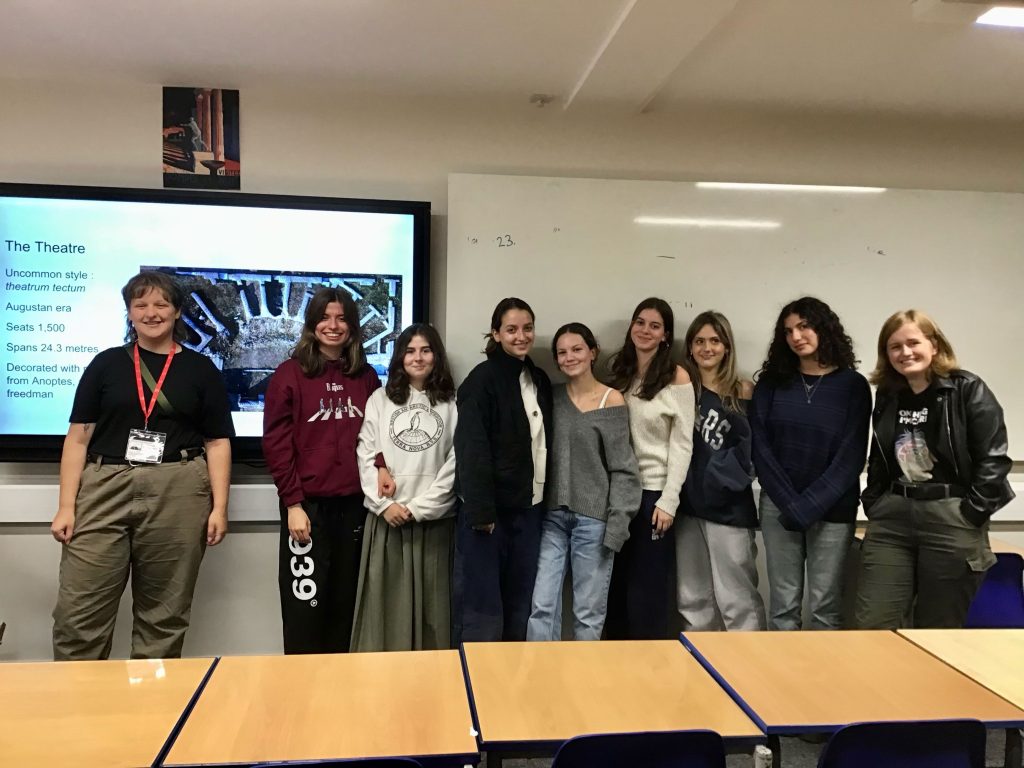
Before half-term, 45 Classicists in Years 11 and 12 immersed themselves in Ancient Greek Tragedy with a visit to Cambridge to see this year's Greek play - Aeschylus' Agamemnon. We first heard a fascinating lecture from Dr Jennifer Wallace, who explored which is the decisive moment in the play and made interesting comparisons with Shakespearian tragedy. After lunch and some time to catch up with ex-Channing students currently studying at Cambridge, we settled into our seats in the Arts Theatre to see the play itself. It was an extraordinary experience as it was performed in the original Greek, giving us a chance to understand what it must have been like for a Greek audience.The production was staged with impressive competence by the student cast and we were all struck by the rhythm and subtleties of the language. Particularly exciting was seeing Sophia Crawford's performance as the herald celebrating relief at the end of the war, a former Channing student.
Year 11 and 12 Classics students in Cambridge