
 VISIT US
  CONTACT US
  SUPPORT US
 APPLY NOW
The trip overall and the Generator Hostel
On July 5, 2025, a group of 41 students and I were given the incredible opportunity to travel to Berlin, Germany, to explore the city while deepening our knowledge of History and German. After an early start, we quickly found our way through Berlin, and there was never a dull moment. We visited many famous and historic landmarks, including Checkpoint Charlie and the Memorial to the Murdered Jews of Europe, where we were able to immerse ourselves in Germany’s fascinating history. We stayed at the Generator Hostel, which was excellent and conveniently located in the heart of the city. Overall, it was a trip like no other, and we are all extremely grateful to the five teachers who made it possible. We created unforgettable memories and cannot thank them enough for providing such a wonderful experience.
Amelia S, Year 11
Checkpoint Charlie, The Reichstag and its Dome
Our visit to Berlin gave us the chance to see history right in front of us. At Checkpoint Charlie, the most famous crossing point between East and West Berlin, It really helped us to picture how tense it must have been during war. It gave us the opportunity to reflect on how families were once separated by the border that ran through this spot. Later, we went to the Reichstag, which felt completely different. The building itself was impressive, but the highlight was the Glaskuppel (glass dome). Walking up the spiral ramp gave us an amazing view across the whole of Berlin. It also symbolises Democracy in Germany, as visitors can look down into the debating chamber. I found that seeing both places in one day showed the contrast between Berlin’s divided past and how it is today.
Lili B, Year 11
Memorial to the Murdered Jews of Europe
The memorial to the Murdered Jews of Europe is in the middle of the city of Berlin and is a place of remembrance for the up to six million Jewish victims of the Holocaust. As we walked through the rows it created a sense of unease and isolation reflecting the horror experienced during the holocaust it helps us to reflect on the fear, confusion and loss that many Jewish families were experiencing at the time. The slabs have no names because the memorial is meant to represent all the victims equally. The design is also this way to encourage visitors to think in their own way. It has a very powerful and symbolic meaning and is also a way of keeping the memory of all those who died alive.
Amelia D, Year 11
Brandenburger Tor & Unter den Linden
The Brandenburg Gate was a symbol of division, but now symbolises the reunification of Germany. We really enjoyed strolling Unter den Linden (‘under the linden trees’) which was originally a bridlepath. It is a grand boulevard and a crucial site for tourism, containing landmarks, famous museums and the Humboldt University, showcasing Germany’s relevance on the world stage.
Elfie W, Year 11
Sachsenhausen
During our trip we were able to visit the concentration camp Sachsenhausen. Visiting this camp was a really powerful experience that helped us all understand the true scale and horror of what happened to the people sent to concentration camps. Walking through one of the barracks, with a small room that would fit over 200 Jewish people, walking through grounds with hanging poles and looking at the gas chambers that were disguised as a doctor’s room, made the history seem very real and personal in a way learning about them in lessons can’t. It was incredibly difficult and upsetting to see such a site, but it was also an important opportunity to reflect on history and remember the victims of these places.
Caye B-F, Year 11
East Side Gallery
During our trip to Berlin, we visited the East Side Gallery, which is the longest remaining section of the Berlin Wall. It was like stepping into history in an open-air art gallery. Originally it was part of the Berlin wall but then 100 artists from 21 countries were invited to paint on the preserved section of the wall to celebrate the fall of the Wall and the end of the Cold War. Each artwork represents freedom, hope and most importantly the unification of the city. My favourite artwork was definitely the famous Brezhnev and Honecker kissing as it represented the special relationship between Communist countries.
Leila A-H, Year 11
The DDR Museum
During our trip to Berlin, we got the wonderful opportunity to visit the DDR Museum in the centre of Berlin, where we were brought back in time as the interactiveness and detail of the museum made us think we were in a flat in East Germany. This made us contemplate what everyday life would be like and how different it is to ours. The many installations invited us to join in and interact, discovering unique objects. We were able to experience the history and former life of the German Democratic Republic (DDR) first hand and learn about the Stasi Surveillance. Both the positives and the negatives of the DDR were portrayed.
Regina G, Year 11
KaDeWe
During our trip to Berlin, we had the opportunity to visit KaDeWe. KaDeWe is a luxury department store on the west side of Berlin. It is the most famous department store in Germany and one of the largest in Europe. The luxurious and modern area of West Berlin proved to be an interesting comparison to the historic architecture of the East. We looked around the six floors of the store, looking in the windows of many designer brands. We were able to look in many different shops and some of us bought some things as well. We were so thankful for the teachers for allowing us to go shopping, we had so much fun!
Eleanor C and Matilda W, Year 11
The German Programme
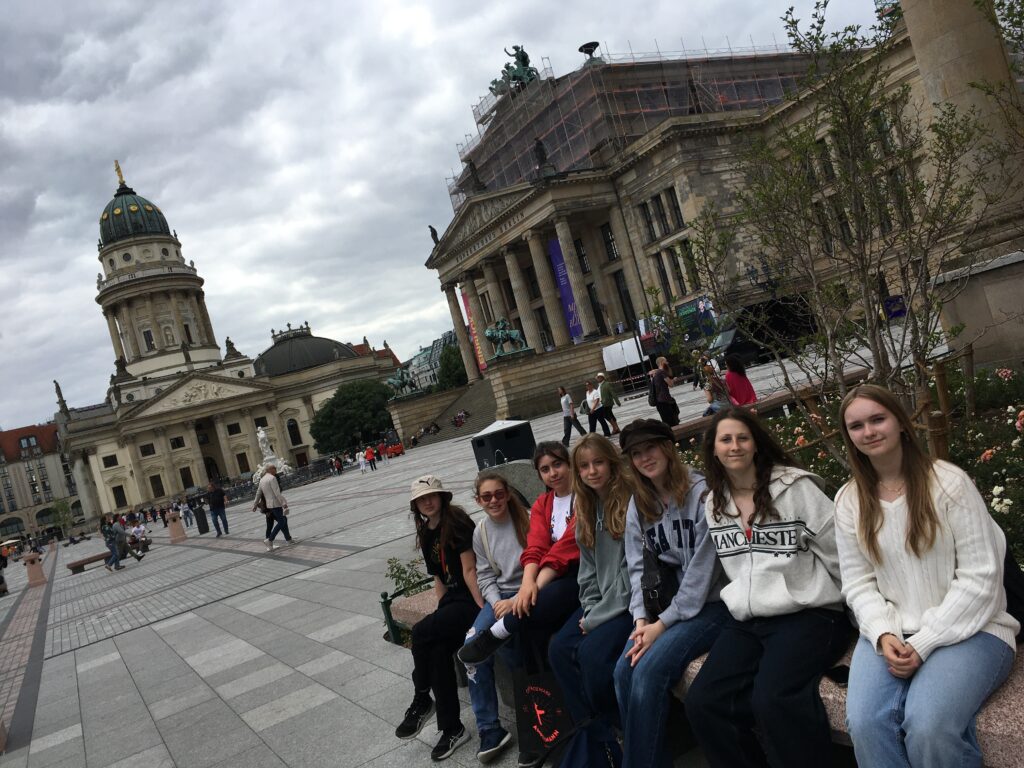
German students also enjoyed a trip to the Gendarmenmarkt, an outing to a show at the Tipi am Kanzleramt, another to the iconic Zoo Palast Cinema to watch ‘How to train your Dragon’ in German and of course a stop at the chocolate shop RitterSport. Musical delights were planned for Year 12 students: a masterclass by baritone Thomas Quasthoff, Liszt and Richard Strauss conducted by Christian Thielemann at the Philharmonie and a concert by the children’s choir of the Berlin State Opera.
On the last day, all the German students visited the Stasi Museum (Staatsicherheit, meaning state security) museum in East Berlin, at the former Ministry of State Security headquarters, where the Stasi operated. It was an extremely interesting and somewhat surreal experience for example, seeing the preserved office of Erich Mielke, the former head of the Stasi, and other original equipment. We had the opportunity to learn about their methods of surveillance, control, and repression, which gave us a better understanding of life in East Berlin and the DDR regime. One cool fact was that Tatjana Besson from the punk band Die Firma (The Firm) was actually a spy for the Stasi.
Aurora H, Year 12
The German students also had the opportunity to meet with three very interesting people: the lutenist Wolfgang Katschner, who was born and brought up in the former GDR, and Herr and Frau Bühler kindly invited us to their home in Berlin for dinner and a conversation in German about their experiences with the East/West divide before we had to leave for London. They had many entertaining and sometimes tragic stories to share, and Frau P helpfully provided translations when necessary. After dinner, we thanked them for the delicious ice cream and waved goodbye to Germany.
Ellie S, Year 11