
 VISIT US
  CONTACT US
  SUPPORT US
 APPLY NOW
Geography
As another vibrant academic year draws to a close, it is a pleasure to reflect on what has been a truly fantastic year for the Channing Geography Department. Our students have shown incredible curiosity and enthusiasm, tackling complex global issues while engaging deeply with the world around them.
None of this success would have been possible without the tireless dedication, passion, and energy of our exceptional geography staff. Whether inspiring students in the classroom or leading fieldwork in all weathers, their commitment to bringing geography to life is what makes our department so special.
This year has been particularly memorable for our enrichment programme. Through an extensive range of fieldwork, students experienced physical and human geography firsthand while developing vital practical skills that cannot be replicated in the classroom. We were also privileged to welcome outstanding guest speakers, including Tim Marshall and Lewis Dartnell, whose expertise and research sparked thought-provoking debates and inspired our next generation of geographers.
To the team, thank you for your creativity and hard work throughout the year. To our students, thank you for your energy, curiosity, and intellect. We look forward to another year of exploration and discovery ahead!
Year 7: Kew Gardens
By Avonlea and Natalie
On 4 June, Year 7 went on a Geography field trip to Kew Gardens.
Upon arrival, we headed to the Temperate House to learn about the key plant adaptations that help plants survive colder conditions. Afterwards, we followed a Kew Gardens staff member to the Palm House. There, we used different tools to measure and compare soil moisture, air temperature and humidity between temperate and tropical environments.
We also studied a variety of plants, took measurements, and discussed both their everyday uses and the environmental threats facing their habitats. Alongside this, we explored wider global challenges surrounding deforestation and the impact of commercial plantations.
We had a short lunch break beneath a giant mushroom sculpture before visiting the Hive, where we explored plants from around the world. We finished the day with the Treetop Walkway.
Year 8: Battersea Power Station
By Darcy
On 18 March, we visited Battersea Power Station to investigate its sense of place and sustainability.
We carried out a range of fieldwork investigations, including aroma tests, mood mapping and decibel surveys, to analyse the smells, atmosphere and sound levels across three distinct areas of the site. While exploring Area B, we had the incredible opportunity to ascend Lift 109, which provided spectacular 360-degree panoramic views across London.
Following a lunch break by the River Thames, we completed further fieldwork inside and outside the Power Station before ending the day with a scenic Uber Boat journey.
CBM Sustainability Award
Back at school, students drew upon their fieldwork experiences to design a more sustainable vision for Battersea Power Station. These designs were submitted as entries for the CBM Award, a Channing sustainability prize now in its 26th year, running thanks to the ongoing generosity of Channing Old Girl and former Governor, Catherine Budgett-Meakin.
Congratulations to our CBM Winners 2026
First: Ruby, Iris, Ella and Amaia
Second: Tabby and Esme
Third: Erin, Ava and Iona-Mae
Year 9: Natural History Museum
By Alice and Rafaella
On 14 October, we visited the Natural History Museum to learn more about the fascinating, yet devastating, challenges the Earth faces today, while also exploring the hopeful solutions that can create a more sustainable future. We watched the immersive documentary Sir David Attenborough – Our Story.
During the trip, we took part in different workshops where creativity, teamwork and research skills were key. In the Fixing Our Broken Planet experience, we explored how scientists are working to repair the Earth, investigated different career paths, and created posters showing how our chosen jobs could help the planet thrive.
In the LEGO® Build the Change workshop, we learnt how architects are designing buildings with sustainability in mind before taking part in a challenge to build structures capable of surviving a changing climate.
This trip taught us so much about our changing world, and we were able to draw upon these ideas throughout our climate change unit.
Origins Society & Lewis Dartnell Talk
By Sylvia and Sophia
Origins Society has become such an exciting part of the week for the Year 7 students involved. The club centres around Lewis Dartnell’s book Origins, which explores how the forces that shaped civilisations continue to influence our world today. Whether we are looking at history, human evolution, or the geological and climatic forces that drove human adaptation, the activities are always engaging and eye-opening. It is fascinating to take part in something beyond the curriculum that combines History and Geography, demonstrating how closely the two subjects are connected.
A particular highlight was welcoming Professor Lewis Dartnell to speak about his book. He explained how the Earth’s geology and climate have shaped human history and even touched on how geology has influenced voting patterns in the UK today. It was amazing to study a book and then have the opportunity to hear directly from its author, making the experience even more enriching.
Year 10: Epping Forest
By Maya and Lyla
On 18 June, we travelled to Epping Forest for our physical geography fieldwork. Our main focus was collecting data from Debden Brook, which we will use in the fieldwork section of our GCSE examination.
Before collecting our data, we revisited the rivers topic and discussed the most effective methods of investigation. We decided that stratified sampling would be the best approach because it reduces bias, provides representative results and is safe.
We measured the river’s width, depth, velocity and sediment at three different sites before returning to the classroom to analyse our findings by plotting the data on graphs. The trip was really interesting and will definitely help us with our GCSE fieldwork paper.
Year 12: Brick Lane
By Kitty and Sara
Our Year 12 A Level Geography trip to Brick Lane and Spitalfields gave us a great opportunity to deepen our understanding of our place study while developing a range of fieldwork techniques.
In Brick Lane, we carried out questionnaires exploring place identity, Bangladeshi culture and the influence of globalisation. These helped us gain a better understanding of what the area’s identity means to local people and how it has changed over time. We also managed to stop at the famous Beigel Bake for a salt beef bagel.
We then carried out an Urban Dérive around Spitalfields Market, recording photographs, sounds, smells and observations at different locations. It was fascinating to see how quickly the area changed from modern and heavily gentrified streets to older, more historic buildings.
Overall, the trip was an excellent opportunity to investigate place identity while strengthening our fieldwork skills.
Year 12: Flatford Mill & Walton-on-the-Naze
By Annabelle and Bella
Our Year 12 A Level Geography trip to Flatford Mill and Walton-on-the-Naze gave us the opportunity to investigate coastal processes in a real-world environment while developing our fieldwork and data analysis skills.
At Walton-on-the-Naze, we investigated coastal management strategies, collecting beach profiles, infiltration rates and sediment samples to assess how effectively different approaches reduce coastal erosion.
We stayed overnight at Flatford Mill, surrounded by beautiful countryside, which gave us a great opportunity to spend time together outside school. We even saw rabbits around the site. After completing our fieldwork, we enjoyed ice cream on the beach before heading home.
Overall, the trip was both enjoyable and extremely valuable in helping us understand coastal processes through first-hand experience.
Year 12: Day 2 Ipswich Waterfront Regeneration
By Ella and Flora
In Ipswich, we learnt about human geography and the Waterfront regeneration project, assessing how successful it has been. Because we carried out our fieldwork in the middle of the day on a Tuesday, we considered how the timing may have influenced our results. If we were to repeat the investigation, we would collect data across a wider range of days and times to ensure our findings were more representative.
To gather evidence, we carried out a range of surveys across different parts of Ipswich. These included Environmental Quality Surveys, which measured factors such as cleanliness, building condition and the overall attractiveness of the area. We also completed land-use surveys to identify how different spaces were being used and whether regeneration had encouraged new businesses, services and recreational facilities. By collecting and analysing this data, we were able to compare regenerated and non-regenerated areas and draw conclusions about the overall success of the regeneration project.
Year 12: Hampstead Heath (Water & Carbon Cycles)
By Imogen and Hermione
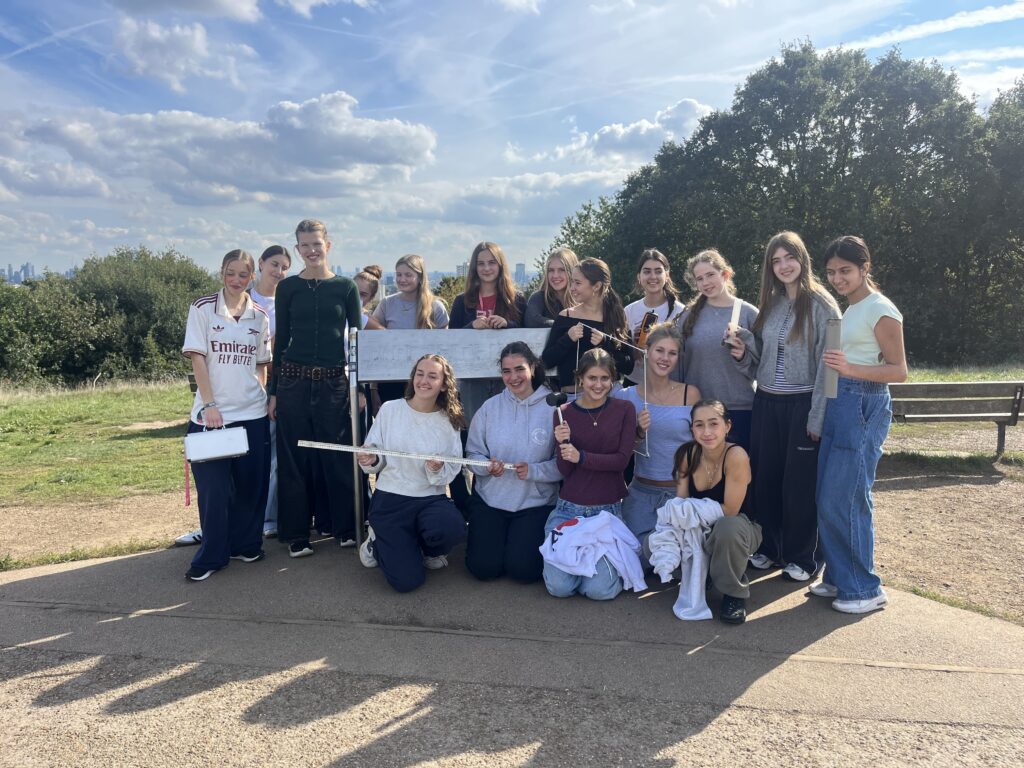
Our field trip to Hampstead Heath provided an excellent opportunity to investigate the water and carbon cycles in a real environment. One of the main activities involved measuring soil infiltration rates at different locations across the heath.
We compared areas with different soil types and land uses, including heavily used footpaths and less disturbed vegetated areas. The results showed clear differences in infiltration rates, with compacted soils on paths allowing less water to infiltrate into the ground, while areas with greater vegetation cover and looser soils had much higher infiltration rates. This demonstrated how human activity and soil characteristics influence the movement of water through the environment.
Overall, the trip helped us connect classroom theory with real-world processes and improved our understanding of the interactions between land use, water movement and carbon storage.
Senior Geography Society and Tim Marshall
Years 11, 12 and 13 geographers met on Thursday lunchtimes to discuss a wide range of current geographical issues. Discussions, led by both staff and students, explored topics including the global decline in birth rates, the impact of wildfires on the carbon cycle, how music connects to geography, coastal management on the Costa del Sol, and how coffee shops can shape a sense of place. We also took a close look at the UN Climate Change Conference in Brazil (COP30). Ahead of Tim Marshall’s visit to Channing, we compiled questions for him and later analysed his presentation, leading to an engaging discussion on geopolitics and geoeconomics.
By Imogen and Stevie
The Senior Geography Society has been a highlight of the week, offering a space to explore the complexities of our changing world beyond the classroom curriculum. Each session balances physical and human geography, bridging the gap between theoretical models and real-world application. Whether discussing demographic shifts, ageing populations or regional environmental crises, the Society encourages us to think critically about current affairs.
A particular honour was the opportunity to interview Tim Marshall. Preparing for the conversation allowed us to develop our academic thinking as we explored the geopolitical ideas presented in his book, Prisoners of Geography. Discussing how physical landscapes influence political boundaries and international relations offered a fascinating new perspective and reinforced the importance of geographical literacy in understanding the wider world.
The Senior Geography Society has played an important role in shaping our understanding of how geography continues to shape our future.