
 VISIT US
  CONTACT US
  SUPPORT US
 APPLY NOW
Extracurricular Clubs
Channing students enjoyed an exceptional range of extracurricular science clubs this year, blending hands-on practical skills with core academic principles.
Anatomy Club: Run by Mrs Rao, this popular club provided an exceptional journey into structural biology. Through careful and respectful laboratory dissections, students investigated individual organs—examining the lensesx and optic nerves within eyes and tracing cardiac valves—before progressing to full frog and mouse specimens to map interconnected systems. Microscopes were used throughout to bridge the gap between visible tissue structures and cellular biology.
Air-dry Clay Club: This initiative allowed students to get creative while reinforcing the curriculum. Participants sculpted highly detailed plant and animal cells, three-dimensional food chains, and healthy eating plates to visually represent healthy nutrition.
Astronomy Club: Led by Mr Daw and Mr Jacobs, the club took an evening trip to Alexandra Palace to observe the night sky. Joined by Year 13 Physics students, they utilised the department’s new high-powered telescope to view the craters of the Moon, the atmospheric stripes of Jupiter, and its surrounding moons. Plans for next year include adding an additional lens and a digital camera module to photograph Mars, Saturn, and distant galaxies, alongside field trips to the Hampstead and Royal Observatories.
Physics in Action Club: Students participated in engineering competitions centered on density, aerodynamics, and fluid dynamics. Highlights included a challenge to build the tallest free-standing tower using only 15 pencils and four strips of masking tape. Congratulations to Miranda and Shireen, whose winning structure reached 64 cm.
Engineering Club: Launched as an extension of the STEMM Society, this four-week program introduced pupils to bridge structural design. Working in collaborative groups, students built their own structural models. A massive thank you to the Year 12 mentors – Amber J, Ava N, and Anya J – who organised and ran these engaging sessions.
Witchcraft and Wizardry Club: Ms Mohabeer inspired students with a chemical approach to magic. Student “sorcerers” conjured custom sheets of slime and delved into the mystical science of fireworks, discovering how different ionic salt compounds produce distinct, vibrant flames.
Science Detectives Club: Dr Spinks supported students in applying forensic science to solve a mock crime. Participants developed critical analytical skills by studying hair samples, testing simulated poisons, and studying fingerprints.
Competitions & Awards
Our CREST Award teams worked tirelessly on independent investigations. Adela H-M, Mayssa A, and Melisa K researched the chemistry of the “perfect cup of tea,” analyzing optimal sugar concentrations, steeping times, and milk preferences. Meanwhile, Thomasina R, Louise B, Delphi M, and Silvia O-M focused on formulation, benchmarking a homemade lemon-and-lime soda against commercial Sprite. Congratulations to both groups for successfully earning their Bronze CREST Awards.
Creative engagement continued with the Oxford Centre for Personalised Medicine art competition, which invited students in Years 7–9 to explore the concept of individualized healthcare through visual media.. Our girls enjoyed success; Nyah A-B in Year 7 was awarded the joint runner’s up prize with her DNA-staircase painting, and Cleo F and Sadie M, also in Year 7, were joint winners of the competition with their depiction of an hour glass.
In June, Year 9 students attended the STEM Challenge Day at the University of West London. The event opened with a lecture by Professor Anastasia Sofroniou, who highlighted the historic contributions of female pioneers to technologies like Wi-Fi and Bluetooth, inspiring our aspiring scientists.
Students then competed in three practical categories:
Forensic Science: Creating accurate facial composites of suspects using EFIT software.
Medicine: Learning to take vital signs, diagnose symptoms, and perform CPR.
Robotics: Programming autonomous robots using sensor arrays, culminating in a competitive robot battle.
Student Reflection:
“The STEM Challenge Day was an inspiring experience that increased my passion and strengthened my interest in pursuing a career in science and technology.” — Aayushi Mishra, Year 9
Congratulations to Aayu M, Silvia O-M, Saisha D, and Saumya S, who were members of the winning challenge teams!
Key Stage 4 (KS4)
Scientific Thinking Challenge
Year 10 students once again tested their analytical skills in the National Scientific Thinking Challenge. We achieved a fantastic haul of certificates this year. A significant proportion of the cohort achieved Bronze awards (placing in the top 40% nationally) and Silver awards (top 25%). Particular congratulations go to our Gold certificate recipients: Eve P, Lydia O, Milla C and Orla D, who placed in the top 10% of all candidates across the country.
The All Nature Team (ANT)
This year, our long-standing “Fish Club” underwent a rebranding to become the All Nature Team (ANT), celebrating the Biology department’s first active ant farm.
The Year 10 team transformed the aquatic environment by removing all synthetic decorations from the tank. Shifting to a more natural, heavily planted ecosystem kept the water cleaner for longer, allowing our aquatic life to thrive. The community welcomed several new additions, including six Longfin Green Tiger Barbs, an Electric Blue Ram, and a Longfin Blue Eyed Bristlenose.
Alongside the tank, the new ant farm is flourishing beautifully—even if the queen remains camera-shy. The ecosystem is currently spending the summer at Mrs Hillier’s home in preparation for its move to our brand-new, state-of-the-art science laboratories. We look forward to recruiting an enthusiastic new cohort of students to take the reins next term.
STEMM Society
Channing is delighted to mark the inaugural year of the STEM and Medical Society (STEMM Society), envisioned and launched by Lucia K (Year 12). Open to students from Years 10 to 13, the society provides an intellectual space for exploration beyond the standard curriculum.
The debut session tackled antimicrobial resistance, sparking critical debate on what is frequently cited as the next global healthcare crisis. Subsequent meetings featured an inspiring guest speaker who detailed his professional transition from studying Biomedicine at Imperial College London to completing a law conversion, alongside a deeply moving, research-focused session on Alzheimer’s disease. The society continues to welcome all students looking to present a topic or join the debate.
A-Level
Biology Olympiads & Fieldwork
British Intermediate Biology Olympiad: Year 12 Biology students tested their problem-solving abilities in this global online competition, answering complex multiple-choice questions that bridged GCSE knowledge and advanced A-level principles.
British Biology Olympiad: This highly demanding competition consists of two 45-minute papers testing knowledge from the entire two-year A-level syllabus and beyond. Kudos to all who sat the exam, with special recognition to our award winners: Clara E and Sophie S (Commended); and Kiki T, Alex M, Lucy O, and Lucia K (Bronze).
In September, Year 12 Biologists braved torrential rain at the Epping Forest Field Studies Centre to conduct ecological fieldwork. Using standardized sampling techniques, students gathered raw data to calculate and compare the biodiversity of two distinct aquatic environments via Simpson’s Biodiversity Index. In the afternoon, random sampling techniques were deployed to investigate species abundance across areas of contrasting light intensity, giving students a first-hand understanding of ecosystem complexity.
Oxbridge Biology Society
Designed to prepare Year 12 and 13 students for competitive applications to Oxford and Cambridge, this dedicated society meets weekly to stretch academic boundaries. Students research and present on niche biological interests, sharpen their quantitative data analysis skills, and engage in mock academic interviews. We are thrilled to congratulate Natasha H on securing a provisional Oxbridge offer for the upcoming academic year.
Lincoln Essay Competition
Well done to Lucia K, Alex M, Sophie S, Jessica T, and Zinnia W for their thought-provoking entries to the prestigious Lincoln Essay Competition.
Alex M & Sophie S explored the hidden architecture of non-coding DNA, detailing its critical role in gene regulation, protein production, and gene-editing therapies like CRISPR.
Lucia K & Zinnia W tackled the question “Is AI going to make doctors redundant?”, arguing persuasively that while artificial intelligence accelerates diagnostic efficiency, it cannot replace the empathy, ethical judgment, and human connection at the heart of medicine.
Jessica T investigated the biochemical feasibility and ethical risks of creating “mirror life,” concluding that the potential biosecurity hazards of self-replicating mirror organisms outweigh their immediate scientific benefits.
Chemistry Competitions & Conferences
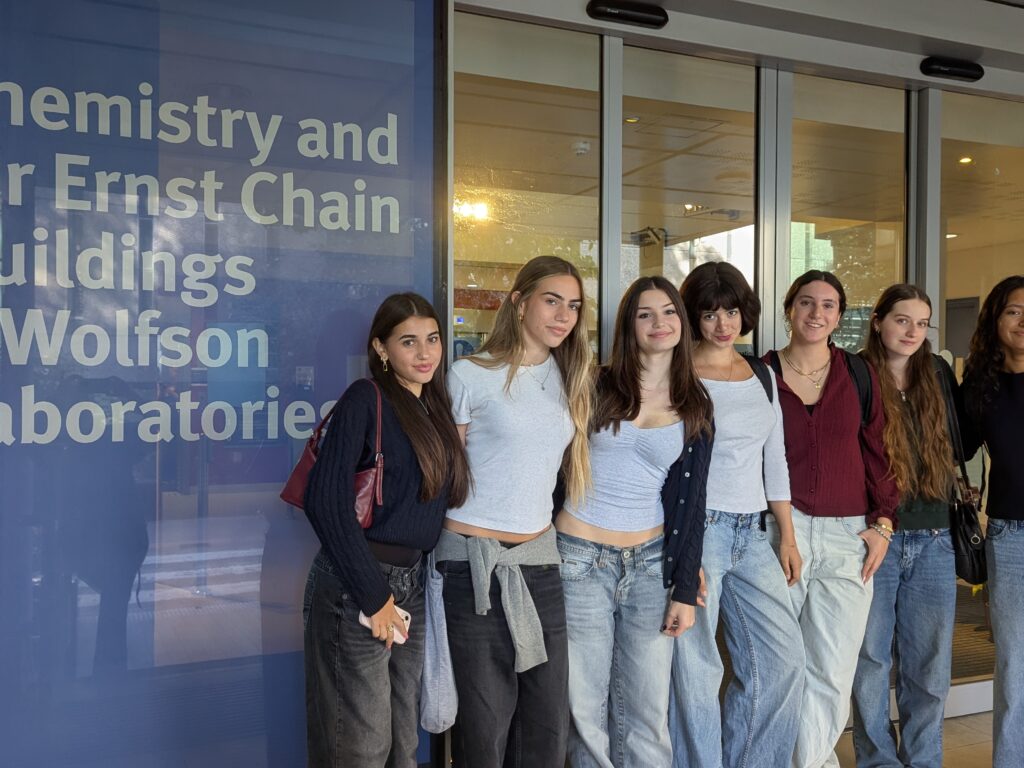
Imperial Taster Day: In September, a group of seven Year 12 students attended a taster day at Imperial College. They learnt about STEM pathways and performed a kinetics experiment in the university laboratories.
UK Chemistry Olympiad (UKChO): In January, our Sixth Form chemists took on this elite national challenge to solve complex, real-world chemical problems. Congratulations to all who participated, including Anya J, Imogen C, Ruby C, Valeria D, Charlotte W, Lara G, Lucia K, Piper C, Rukmini B, Sophie S, and Alex McN.
The Chemistry Race: In February, a five-member Year 12 team named “The Titrators” (Anya J, Lucia K, Alex McN, Sophie S, and Charlotte W) traveled to Cambridge University. Competing against teams heavily populated by Year 13 students, they raced against a live leaderboard to solve complex analytical problems within a strict two-hour limit, demonstrating exceptional teamwork and grit.
RSC Schools’ Analyst Competition: In June, Year 12 chemists acted as forensic investigators to solve a fictional poisoning mystery at a local pharmacy, applying analytical lab techniques to real-world criminal justice scenarios.
Cambridge Chemistry Challenge: Six of our Year 12 students pushed themselves significantly past the A-level syllabus to tackle university-level problems. Well done to Rukmini B, Piper C, Lucia K, Alex M, Sophie S, and Zinnia W.
Our chemists also attended the Chemistry in Action conference in Westminster, featuring an array of boundary-pushing lectures, which included discussions about uranium isotope decay, the impacts of mining for tech metals and the impact of isomerism on scent.
Physics in Action
Year 12 and 13 Physics students traveled to the Emmanuel Centre for a day of specialized lectures covering deep-sea exploration, space weather, and exam strategy.
Student Reflection:
“My favourite talk was by particle physicist Kate Shaw, who discussed the Standard Model and her work on the ATLAS experiment at CERN. I also loved Professor Brendan Walker’s lecture on the physics of maximizing rollercoaster thrill levels. It opened my eyes to the diverse applications of physics.” — Catherine S, Year 13