 VISIT US
  CONTACT US
  SUPPORT US
 APPLY NOW
It has been a year of rich exploration, deep reflection and creative risk-taking within the English Department. From nuanced academic inquiry and formal debating to the quiet dedication of our writing workshops and theatrical excursions, students across all key stages have engaged thoughtfully with the power of language. Guided by curiosity and a willingness to embrace the unfamiliar, pupils have stepped beyond the pages of their textbooks, discovering that literature is a living, breathing landscape to be performed, interrogated and inhabited.
The academic year opened with a celebration of National Poetry Day, which took Play as its central theme. In the study of literature, play is not a distraction from serious thought but one of its greatest catalysts. It encourages students to experiment with language without fear of failure, entering what educational theorist James Nottingham terms *The Learning Pit*—a space of uncertainty where resilience ultimately leads to deeper understanding.
To mark the occasion, Year 13 Literary Society members Opal, Maisie and Yasmine led a whole-school assembly exploring the history of riddle poetry. They invited the community to see reading as an active, joyful puzzle, tracing a line from the hidden answers of Jonathan Swift to the elliptical verses of Emily Dickinson.
The assembly inspired a Write Your Own Riddle Poem competition across Key Stages 3 and 4, prompting an array of inventive entries full of wordplay and clever imagery. Dr Hayward and Ms McHugh judged the submissions, looking for that hallmark of every great riddle: an answer that feels both surprising and inevitable.
Our senior students have continued to push well beyond the boundaries of the standard curriculum. Within the Literary Society, presentations ranged from a critical commentary on satire and the male author, evaluating Larraquy’s *The National Telepathy* and Nabokov’s *The Enchanter*, to explorations of the Dreyfus Affair’s influence on nineteenth-century French literature, the evolution of pagan Alpine folklore, changing representations of neurodivergence, and the duality of female characters through the lens of *The Madwoman in the Attic*.
In November, Year 11 and A Level English Literature students attended a one-day conference at the Friends’ Meeting House in Euston, organised by the English and Media Centre. A programme of stimulating lectures and discussions included a collaborative poetry workshop comparing a poem by Phillis Wheatley with a contemporary work by its author, Victoria Adukwei Bulley. The day concluded with Andy Miller’s engaging lecture, *The Very Angry Caterpillar*.
The department’s writing clubs have continued to provide sanctuary for linguistic experimentation. Key Stage 3 students explored short stories, descriptive prose and poetry throughout the year. Inspired by National Poetry Day, they composed pieces modelled on Edip Cansever’s *The Table*, examining how ordinary objects can hold profound emotional resonance. Zoe S (Year 8) was named runner-up in the Martha Mills Young Writers’ Prize 2025, earning publication and a launch event at the London Review Bookshop.
Meanwhile, the Years 10–13 writing workshop provided older students with dedicated time to develop their prose and poetry. Roxy F (Year 10) received global recognition in the ISEB/IAPS Time to Write competition, where her short story *Thread* was awarded a Highly Commended certificate from among thousands of international entries.
Stepping beyond the classroom allowed texts to reveal new dimensions. In late autumn, Years 12 and 13 visited the National Theatre to see Shakespeare’s *Hamlet*. The production brought psychological immediacy to the stage, illuminating the play’s enduring preoccupations with grief and moral uncertainty while reminding students of the transformative difference between reading a script and experiencing it in performance.
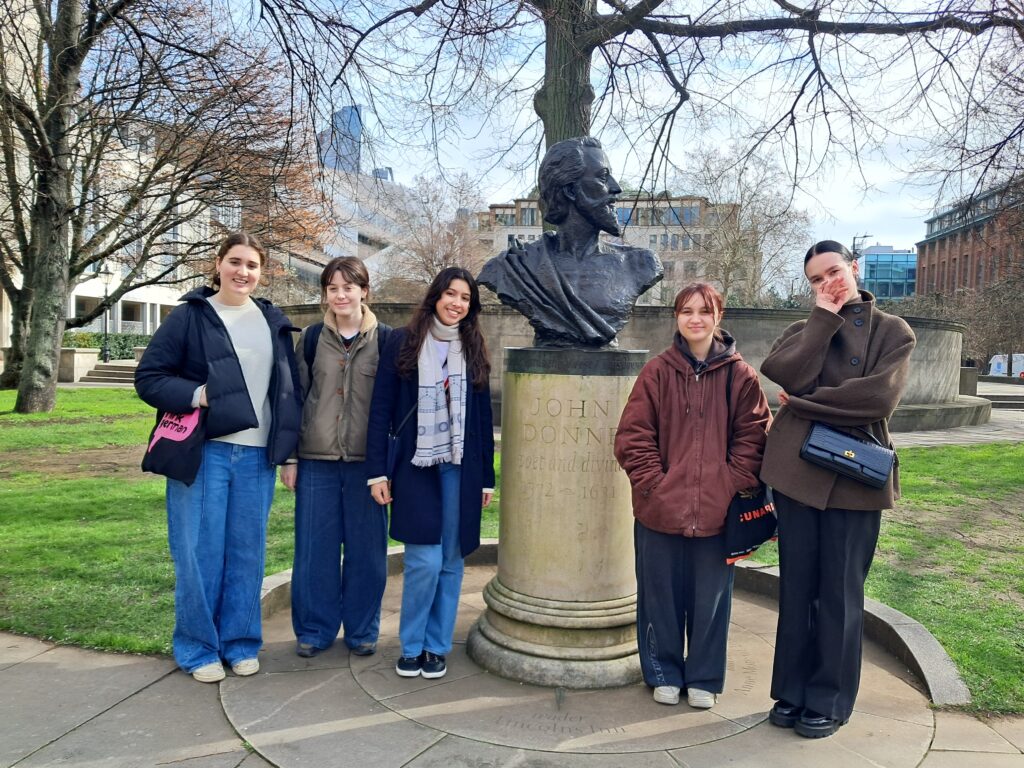
In March, Year 13 students embarked on the A Level John Donne Walking Tour through the City of London. Tracing the metaphysical poet’s journey from his birthplace in Bread Street through Lincoln’s Inn to St Paul’s Cathedral, history and verse came vividly to life beneath the spring sunshine.
For Key Stage 3, Year 8 pupils attended a moving one-man performance of *Mr Owen’s Pocket Book* by Redheart Theatre, providing a fitting conclusion to their study of First World War poetry. Meanwhile, Years 7 and 8 celebrated independent reading through a showcase assembly featuring student-led reviews and creative film trailers for texts including *Saffiyah’s War*.
Creative Arts Week formed another major highlight of the Spring Term, centred on deconstructing tropes and stereotypes in the arts. Activities included a spirited reading battle exploring patriarchal subversion in *Cinderella Is Dead* and *A Doll’s House*, a *Six!* theatre workshop, and a visit from Booker Prize-shortlisted author Stephen Kelman. Kelman led a descriptive writing workshop for Year 10 before speaking about his novel *Pigeon English*, reflecting on childhood, unrealised potential and the creative process.
This coincided with our World Book Day celebrations, which featured literary salons, book quizzes and a Blind Date with a Book exchange. During lunchtime, teachers shared readings from favourite texts spanning P. G. Wodehouse, Michael Crichton and Elif Shafak, alongside a lecture exploring the complex literary relationship between Sylvia Plath and Ted Hughes. The week concluded with an International Women’s Day assembly entitled Girls to the Front, examining contemporary reinterpretations of archetypes such as the wicked witch and the siren.
Finally, the Senior Debating Team demonstrated sharp critical thinking while hosting the first round of the English Speaking Union competition. Arguing in favour of banning short-haul flights where viable alternatives exist, first speaker Saira C, second speaker Amelia D and summary speaker Leila A navigated a spirited evening of rhetoric against formidable opposition, gaining valuable insight into the mechanics of formal debate.
The department extends its warm thanks to all the staff and pupils whose curiosity, creativity and passion for language made this year so memorable.