
 VISIT US
  CONTACT US
  SUPPORT US
 APPLY NOW
There have been plenty of exciting activities both inside and beyond the curriculum in Computing this year, giving pupils opportunities to develop their programming, problem-solving and computational thinking skills through competitions, workshops and hands-on projects.
Disneyland Paris STEM Trip
Students in Years 9, 10 and 12 enjoyed a memorable trip to Disneyland Paris, combining the excitement of the parks with a fascinating insight into the mathematics, computer science and engineering behind the magic.
As part of the visit, students attended exclusive conferences led by Disney professionals, where they discovered how mathematics, data analysis and computer science are used to design attractions, manage visitor experiences and create immersive storytelling. They also had the unique opportunity to explore some of the behind-the-scenes technology that brings the Disney experience to life.
One of the highlights of the trip was gaining sneak previews of upcoming attractions and innovations, offering students a glimpse into the future of theme park design. These sessions demonstrated how creativity and technology work hand in hand, inspiring many students to consider future careers in STEM.
There was also plenty of time to enjoy the parks themselves. From thrilling rides and themed lands to the spectacular fireworks display, students saw first-hand how the mathematical, engineering and computing concepts discussed during the conferences are brought to life.
The trip provided the perfect blend of education and entertainment, demonstrating how classroom learning can translate into exciting real-world applications.
Bebras Computational Thinking Challenge
Pupils from Years 7, 8 and 9 took part in this year’s Bebras Computational Thinking Challenge, achieving an outstanding set of results.
More than 460,000 students entered the competition nationwide.
The Junior Challenge attracted 156,558 participants, making Channing’s achievements particularly impressive. For the first time in the school’s history, six pupils achieved full marks. Channing’s average score of 86 points significantly exceeded the national average of 68 points. Twenty pupils were awarded Certificates of Merit, while 28 received Certificates of Distinction.
Similarly impressive results were achieved in the Intermediate Challenge, taken by Years 8 and 9. Among the 268,615 students who participated nationally, Channing pupils achieved an average score of 87 points, compared with the national average of 67 points. Twenty-nine pupils received Certificates of Merit and 31 were awarded Certificates of Distinction.
Congratulations to all pupils who earned Gold and Distinction certificates and qualified for The Raspberry Pi Foundation Coding Challenge.
Bebras Round Two: The Coding Challenge
Students from Years 7, 8 and 9 also competed in the second-round Bebras Coding Challenge. Having never previously received awards at this stage of the competition, it was particularly rewarding to celebrate success this year.
The challenge is especially demanding, with the Navigator tasks requiring pupils to solve GCSE-level programming problems through complex coding scenarios.
Among the 48,999 students who entered the Novices Challenge nationally, 19% of Channing’s Year 7 pupils achieved Distinction, while 33% received Merit. Gold Awards are presented to the top 10% of participants nationwide.
Congratulations to all pupils who achieved Gold Awards, with special recognition to Natalie, who achieved the highest score in the school.
Henney Computer Graphics Competition 2026
The Henney Prize for Computer Graphics is open to all Year 7 pupils and celebrates outstanding creativity using digital graphics software.
This year’s competition attracted a number of impressive entries, demonstrating both artistic flair and confident use of digital design tools. Ella (7FD), Shireen (7LR) and Sophia (7NQ) were highly commended, while the overall winner was Nyah (7LR).
Robotics and Coding Club
Pupils from Channing and St Aloysius’ College worked together to build and programme VEX IQ robots. Using controllers and coded instructions, they guided their robots through obstacle courses while completing a series of engineering challenges.
Gouled and Anthony built the V-Rex robot, IKE, while Eligh and Noor successfully constructed the Clawbot.
Coding, Collaboration and Culture: Year 7 Robotics Workshop with Hong Kong Pupils
Year 7 pupils recently took part in an exciting international Robotics Coding Workshop alongside students from Hong Kong, combining coding, creativity and cross-cultural collaboration.
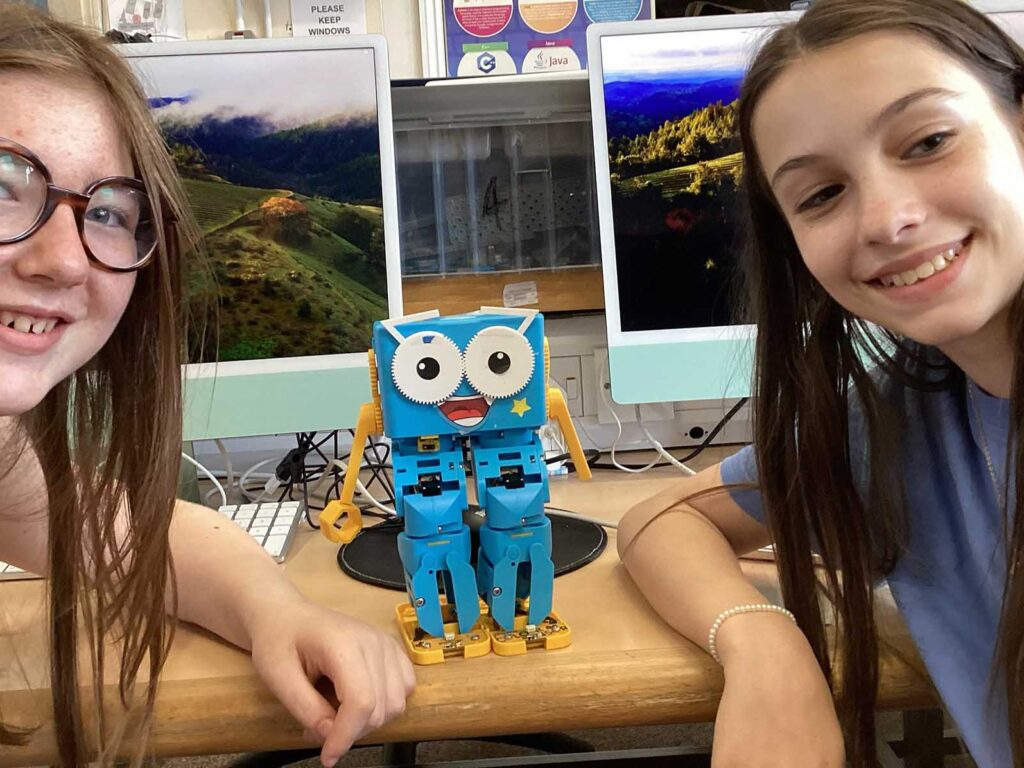
Working in mixed teams, pupils programmed Marty the Robot to solve real-life problems within a school environment. Along the way, they developed new programming techniques while exploring how coding can be used to tackle everyday challenges.
The winning team designed a robot capable of cleaning classroom whiteboards, while another programmed their robot to deliver food in the dining hall. The imaginative solutions showcased not only impressive coding skills but also excellent teamwork and problem-solving.
Beyond the technical challenge, the workshop provided a valuable opportunity for pupils to exchange ideas with students from another part of the world and learn more about each other’s cultures.
Reflecting on the experience, Carla (7FD) said:
“My favourite part of the workshop was meeting the Hong Kong students and coding the robot.”
Emily (7FD) added:
“I had so much fun working with the Hong Kong pupils while we were creating and presenting our designs.”
The workshop strengthened pupils’ programming skills while encouraging collaboration, creativity and a broader global perspective.
Year 8 Marty Robots
Year 8 pupils brought robotics to life through an exciting project that combined coding with creativity.
Using Python, pupils learnt how to programme loops and sensors to control the robot’s movements before progressing to more advanced challenges, including moving the robot’s arms and changing its facial expressions when it detected a person.
As a final task, each robot was programmed to greet people with its own personalised spoken message.
Computer Science: micro:bit
Year 9 pupils put their programming skills into action by designing interactive games and creative animations using the BBC micro:bit.
Working in Python, they explored animation by adjusting brightness levels and timed sequences to create engaging visual effects. Pupils also made use of the micro:bit’s built-in sensors, programming it to function as both an accelerometer and a temperature sensor.
These practical challenges strengthened their coding, computational thinking and problem-solving skills while demonstrating how programming can be applied in everyday technology.
Adventure Story Generator
Year 9 and Year 10 pupils combined creativity with programming by developing interactive adventure stories using Python or pseudocode.
Their programs prompted users for input, validated responses and generated a unique story each time the program was run. The project reinforced key programming concepts, including selection, validation and string manipulation, while allowing pupils to showcase their imagination.
Below is an extract of the pseudocode and interactive story created by Milla (Year 10), demonstrating both creativity and technical skill.
Year 7 Coding Club Takes Off!
Members of the Year 7 Coding Club have been putting their JavaScript skills to the test by designing and programming their own space-themed games.
Creating objects, controlling movement and refining gameplay mechanics allowed pupils to bring their ideas to life while further developing their programming and problem-solving skills.
Below is a short extract of JavaScript code created by Isla, showcasing the creativity and technical ability on display in Coding Club.
Mr Holmes/Head of Computing