
 VISIT US
  CONTACT US
  SUPPORT US
 APPLY NOW
The Classics Department has had another exciting year, with a wide range of trips and a rich programme of clubs and societies offered both to our own students and to partner schools.
Classics Society has continued to flourish this year, with more and more discussions led by students themselves. The year started strongly, with Siana in Year 12 telling us all about her two-week Ancient Greek Summer School. We also had the pleasure of the Year 12 Classical Civilisation students leading us through their favourite ancient Greek sculptures. Students also enjoyed the termly Classics quizzes (complete with edible prizes) to test their knowledge of the ancient world.
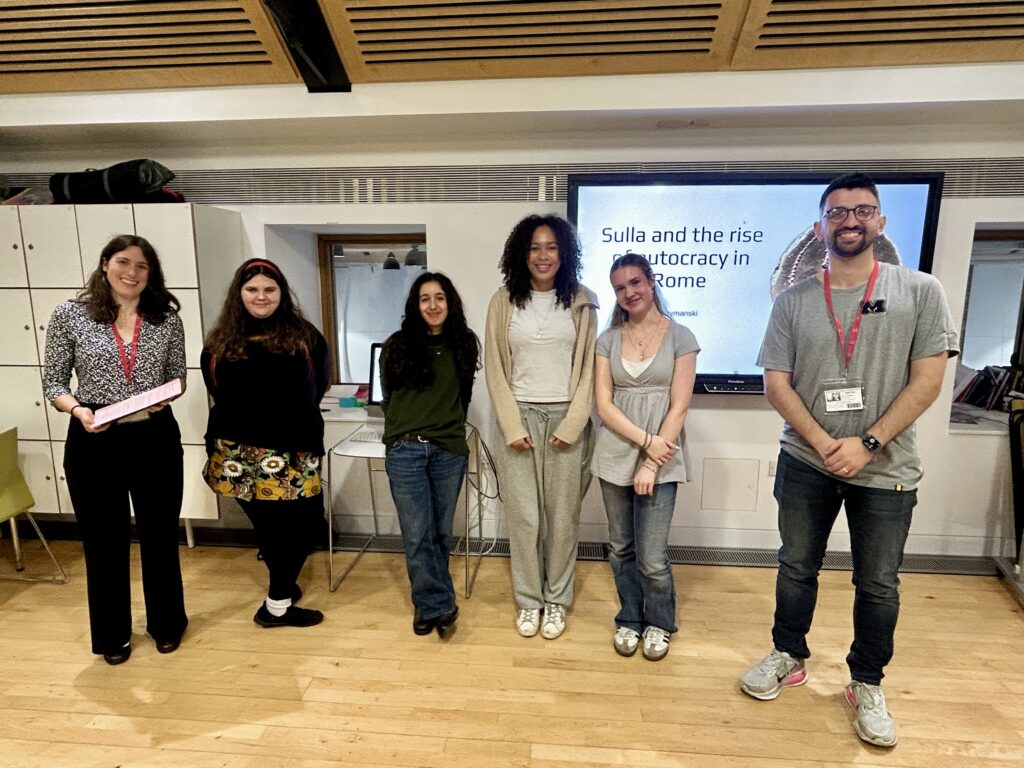
In addition to our fortnightly Classics Society talks, we also hosted a Classics Symposium in January. We were delighted to welcome students from La Sainte Union, St Aloysius’ College and Francis Holland Regent’s Park. Over drinks and nibbles, we enjoyed fascinating talks on Sulla’s role in the decline of the Roman Republic by Dr Will Szymański and the role of women in Greek theatre by Dr Imogen Stead.
The Classics Department took two trips to the British Museum this year. The first, in December, saw our Year 11 Classical Civilisation students visit the magnificent Parthenon Marbles, one of their GCSE prescribed sources. They also enriched their knowledge of ancient Greek art in preparation for A Level by viewing sculptures and pottery from the 5th century BCE. Our second visit, in June, was with Year 12, when we were fortunate to work alongside the History of Art Department. Not only did Year 12 Classicists deepen their understanding of Greek art by studying original ancient artefacts up close, they also enjoyed a private tour of the Early Netherlandish Drawings exhibition with the curator, broadening their cultural knowledge even further. Both visits sparked thoughtful discussion and deepened the students’ appreciation of the ancient world.
November marked the start of a spectacular programme of Greek theatre-themed events. Ahead of Channing’s production of Hadestown, we took a group of enthusiastic Classicists from Years 10–13 to see the West End production. The story links directly to the GCSE Classical Civilisation course, where students study the myth of Orpheus and Eurydice. It was a wonderful opportunity to compare and contrast ancient and modern interpretations of the myth.
In December, Ms Kennedy organised an exciting trip for Year 8 to see Hercules the Musical in the West End. The afternoon was full of laughter, and the production featured familiar songs from the Disney film alongside new music by the original composer Alan Menken and lyricist David Zippel. Students were captivated by the spectacular costumes, monsters, dancing and special effects. It was also a fantastic introduction to one of the topics studied in GCSE Classical Civilisation, and we hope it inspired many to continue their classical education.
In January, Sixth Form Classicists travelled to the University of Warwick for its annual Ancient Drama Festival. This year’s production was Aeschylus’ Oresteia, one of the oldest surviving Greek trilogies, first performed in 458 BCE in ancient Athens. The performance was complemented by a series of lectures, including a standout talk by Dr Emily Clifford on the links between Greek pottery and the surviving plays. Students responded with thoughtful discussions about the play’s themes and visual storytelling.
During the Spring Term, all of Year 7 participated in the Classical Association’s Ovid Competition. They explored one of the myths from Ovid’s Metamorphoses before creating their own responses. We had some truly outstanding entries, with three students receiving particular recognition. Congratulations to Beatrice W (7JG), who was highly commended in the Creative Writing category for her poem about Diana and Actaeon; Destina S (7CWi), who was runner-up in the Performance category for her musical retelling of the story of Minos; and Kitty C (7JG), who won the Animation category with her brilliant interpretation of Diana and Actaeon. Congratulations to everyone who took part!
The excitement for Year 7 continued into the Summer Term with a sunny visit to Verulamium in Roman St Albans. Students admired the beautifully preserved mosaic and hypocaust – a precursor to modern central heating – before handling genuine Roman artefacts at the museum. A particular highlight was the dress-up session, where students took on the roles of Roman and British citizens to gain a deeper understanding of the social hierarchy of the time.
The Classics Department also continued to foster strong links with partner schools. Ms Benns led engaging Minimus sessions for students from Brookfield Primary School, St Joseph’s Primary School and Fairseat School, supported enthusiastically by Sixth Form students Siana, Maya, Bella and Amara, who introduced younger pupils to Latin and mythology. Meanwhile, Ms Walker continued the successful Latin Club for students from Acland Burghley School, Parliament Hill School and La Sainte Union. Beginning as complete beginners in September, the students completed OCR’s Entry Level Latin qualification in May, demonstrating impressive progress across the year.
It has been another busy and stimulating year for Classics at Channing. We look forward to another exciting programme of trips and events next year, including the much-anticipated trip to Rome at Easter 2027.
Ms Bannatyne/Head of Classics