 VISIT US
  CONTACT US
  SUPPORT US
 APPLY NOW
Word from the Head – 30 January 2026
Dear Parents,
Every year on Holocaust Memorial Day, we are confronted by a number of so vast it feels impossible to comprehend: six million. It is a statistic that, in its sheer enormity, can inadvertently mask the individual lives, dreams and identities it represents. However, as our History department explored in Tuesday’s assembly, the most powerful way to understand history is not through grand abstractions, but through the small, tangible traces left behind – such as a single suitcase. Their presentation focused on the life of the suitcase’s owner, Hanna Brady, a Czechoslovakia girl who died in Auschwitz at the age of 13 in 1944.
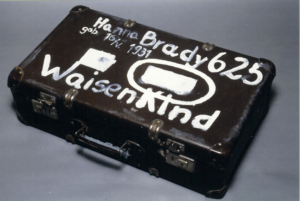
The story of the Holocaust is often remembered by its end point, but the girls reminded us that it began much earlier, rooted in what they described as ‘the slow normalisation of exclusion’. It didn’t start with the camps; it started with the erosion of rights and the shifting of language. Following the political instability of the post-WWI era, the Nazi regime utilised a systematic sequence of controlled steps to dismantle democracy and target Jewish people.
We saw this through Hanna’s eyes: a childhood that was once secure and familiar was stripped away layer by layer. First, it was the hateful rhetoric in the streets, then the laws that barred Jewish people from schools and professions, and finally, the physical removal from their homes to the ghetto. This was the systematic erasure of identity – a deliberate attempt to reduce human beings to mere statistics.
A central theme of Hanna’s story is the power of historical investigation. For decades, Hanna was a name on a list, one of the millions who did not survive. But when her suitcase arrived at a small Holocaust education centre in Tokyo, it sparked a global search for the truth. Centre Director Fumiko Ishioka’s persistence in tracking down Hanna’s story transformed that suitcase from a simple artefact into the physical symbol of Hanna. Through archives and survivor testimony, Hanna was restored as a daughter and a sister. The research proved that while history cannot change the tragic outcome of the past, it can refuse to let a life end in silence. By verifying, and publicising, the details of Hanna’s life, Ishioka negated the Nazi goal of total erasure.
Perhaps the most vital part of the assembly was the reflection that memory is not a passive act. For us to remember Hanna Brady is to accept a civic responsibility in the present. The assembly made it clear that the forces that led to the Holocaust – intolerance, division, and the dehumanisation of ‘the other’ – are not confined to the 1940s. The point was well made that tolerance is not passive: it should be intentional and requires an active, vigilant stance. It means recognising the early signs of prejudice in our own communities and having the courage to speak out against them. Ultimately, Hanna’s suitcase stands as a reminder that history is shaped by the choices societies make every day.
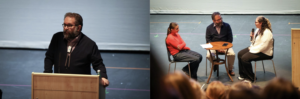
Our whole school assembly followed the Sixth Form Enrichment session on Monday afternoon, in which students were privileged to hear a powerful talk from Dr Jamie Ashworth on this year’s Holocaust Memorial Day theme, Bridging Generations. Dr Ashworth spoke movingly about the importance of memory and understanding, and about the growing urgency of this work as the Holocaust continues to recede from living memory. He reflected on the words of Primo Levi in The Drowned and the Saved, “It happened, therefore it can happen again.”: a valuable prescient message, which was reinforced by the assembly on Tuesday morning. Our thanks to the Holocaust Educational Trust for their support once again this year.
The talk was complemented by powerful student contributions. Year 12 student Maya B shared thoughtful reflections on her recent trip to Poland, while Year 13 student Phoenix M shared the testimony and experiences of her grandfather, Harry Fox, a Polish Holocaust survivor who came to the UK in 1945.
As we look back at Hanna’s life, and listen to our own students’ reflections, we are reminded that remembering is more than just a tribute to the dead; it is a commitment to the living. It is a promise to approach history with care and to ensure that no life, no matter how much time has passed, is ever truly lost to the silence of the past.
With warmest wishes,
Lindsey Hughes
Headmistress