 VISIT US
  CONTACT US
  SUPPORT US
 APPLY NOW
Word from the Head – 13 February 2026
Dear Parents,
As adults we all know that education is more than just a series of lessons. In a conversation with a parent this week I was interested by their differentiation between what it means to be taught, versus to be educated. That latter, wider definition is certainly our aim at Channing and over the course of this year, our Head Girls have been exploring the meaning of an education as both a privilege and a foundation for the future.
Having interviewed two leading journalists (and Channing parents) about the reality of being a girl on the cusp of the second quarter of the 21st century at the GSA Conference in November, they provided their reflections on that experience in a whole school assembly before Christmas. Since then they have also led year group assemblies in which they considered the shockingly poor global picture of education for girls and young women. Their voyage of exploration culminated in Tuesday’s assembly this week, in which Annie and Tash had an inspiring message for students about valuing their opportunities and the power of student voice.
They used the assembly to provide thoughts from the latest School Council meeting in which Form Captains discussed the vital question, “How can we make the most of a Channing education?” Annie reminded everyone that access to such a supportive and resource-rich environment is a fortune not shared by everyone in the world. She pointed out that at Channing, we view education as a vehicle for more than just academic success – it is the primary way our students build confidence, independence and future opportunities.
Tash then reminded everyone about the power of the School Council as a platform where students can shape the changes that affect their daily lives at Channing. She highlighted that when Form Captains attend these meetings, they ensure their peers’ perspectives are heard. Indeed, feedback from the Council meeting showed that our students care deeply about their learning environment and want to see the school improve. Among other things, students identified that involvement in clubs, sports, music and societies is essential for developing friendships and well-rounded skills.
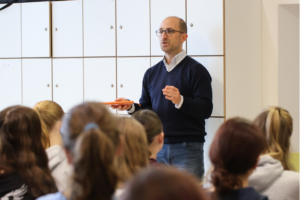
One of the most thoughtful and honest pieces of feedback from the School Council was a request for more clarity regarding the merit and demerit system. Students expressed a desire to understand better what earns a reward and how sanctions are applied. To address this, the Head Girls asked Mr Meier to join the assembly to provide clear explanations and answer student questions. His key message was simple: the school’s rewards and sanctions system is designed to move away from the idea of ‘rules for rules’ sake’ and refocus on consistency and fairness.
Mr Meier emphasised that merits aren’t just for top marks on a test, they are designed to celebrate the Channing Promise. Students earn these for exceptional effort, such as going above and beyond in a task or project, or contributing to the community by stepping up to help a peer or contributing to the school’s positive atmosphere. They are also awarded for active participation in clubs, societies or school events. He also confirmed that we are now looking into more tangible rewards for the accumulation of merits and commendations, beyond the House Cup and certificates, based on the School Council feedback.
To ensure that lessons remain focused on learning, Mr Meier also clarified the ‘Why’ behind demerits. He explained that these are not meant to catch pupils out, but rather to provide gentle course corrections to maintain a respectful environment. He noted that while the school consults pupil opinion extensively, a conversation with a teacher about behaviour is not an invitation to debate. Possible reasons for demerits include disruption to lessons and lateness, emphasising the need to respect the time of teachers and fellow classmates and ensuring that every student’s right to learn is protected. They are also given for uniform and equipment lapses, encouraging students to take pride in their appearance and arrive prepared for the day’s challenges.
Mr Meier closed with a powerful reminder of why these boundaries matter. When students know exactly where the boundaries are, they feel more confident to take creative risks in their learning. By being transparent about these rules, the school ensures that every student – from our newest Year 7s to our departing Year 13s – is treated with the same level of fairness. And by fostering a community where collective needs are balanced with individual ones, we are not only ensuring life in school is positive and collaborative, we are also preparing our students for life far beyond the school gates.
Annie and Tash ended with a lovely exhortation: “Small things really do make a difference. If we look out for each other, follow the rules with a bit of perspective, and make the most of what’s on offer, we can help make school a positive place for everyone.” We are incredibly proud of our students for their willingness to engage in these important conversations. By choosing to be involved and treating one another with respect, they continue to make Channing a vibrant place to learn. You can see Mr Meier’s presentation here:
Assembly Friday 6/2/26 – Expectations and Rewards/Sanctions
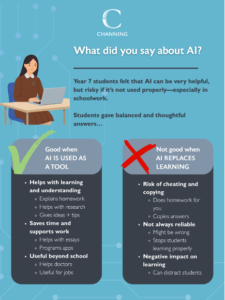
This week has also seen Safer Internet Day 2026, in which pupils across the school took part in structured form-time discussions on the theme of ‘Smart Tech, Safe Choices – Exploring the safe and responsible use of AI’. Our students were challenged to think carefully about how AI is already shaping online experiences, and what Smart Tech, Safe Choices looks like in practice. Mr Grossman, Director of Digital Learning and Technology, has produced an interesting summary of the activities undertaken by each year group, and copies of the slides for your information, which you can read below. It’s great to see the school at the cutting edge of discussions with our students about how they can make the most of AI in their daily lives, as well as highlighting the challenges and dangers that the technology can pose. Dr Kathy Weston of TooledUp Education has also picked this as the theme of this week’s Wednesday Wisdom, which makes for fascinating reading.
As we embark on a well-earned half term holiday I wish you all a happy week of rest and relaxation, with time to catch up with family and friends. Many of you will be celebrating one of the extraordinary confluence of religious days and festivals which fall in the coming week. Whether you are observing Maha Shivaratri or Parinirvana on Sunday, the Lunar New Year on Tuesday, the start of Lent on Wednesday or the beginning of Ramadan on Thursday, I wish you much joy. I know some of you are escaping the rain and heading to the slopes or sunnier climes: wherever you are, I hope it is a wonderful week.
With warmest wishes,
Lindsey Hughes
Headmistress