 VISIT US
  CONTACT US
  SUPPORT US
 APPLY NOW
Word from the Head – 27 February 2026
Dear Parents,
It has been a very busy first week back after half term – and only 4 to go until the Easter holiday! My thanks to Ms Sequeira, Mrs Wootton and Miss Dias who accompanied our Computing and Maths trip to Disneyland Paris in half term. The Year 9 and 10 students attended subject-specific seminars as well as spending some research time on the rides – it was a fabulous experience for all of them.
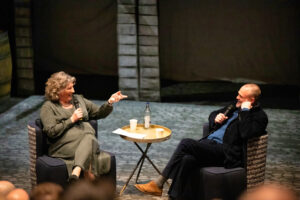
You will not be surprised to know that the highlight of my week was being in conversation with Al Murray last night in the Arundel Centre. Many of us will know of him as The Pub Landlord, but behind the persona is a passionate historian with a deep interest in WWII, triggered by his own family connections. In my conversation with him last night we explored why military history, specifically the history of WWII, should not be a male domain and is actually a gripping psychological drama that is just as engaging for girls and women.
As we discussed, the traditional way we talk about WWII often acts as a barrier. It is frequently presented as a technical account of hardware – tanks, planes and guns – rather than a human story. We agreed that the real allure of WWII isn’t the machinery, it’s the human experience. Malta is a prime example: how extraordinary that an entire island could be awarded the George Cross for its collective bravery during a brutal siege – and that doing so was in itself reported negatively in some quarters in Britain.
Another hurdle is the perceived ‘maleness’ of the narrative. Historically, the focus is on the Big Three, Churchill, Roosevelt and Stalin, or the massive egos of generals like Montgomery. We reflected on the hubris of events like Operation Market Garden, where the calculated risk of using a new weapon (the 1st Allied Airborne Division) to end the war in weeks overrode the lessons of previous failures. Murray’s latest book, Arnhem, focuses on just one 24 period in the four-day battle for the bridge and he made a compelling case for this immersive approach as a way of avoiding the hindsight issues which bedevil history as a discipline.
He also suggested that shifting the perspective can make these stories highly attractive to a female audience. For example, by focusing on decision-making we can offer a perspective on how things could have been done differently, which often resonates with girls. He highlighted the study of war as being a constant stream of trade-offs and compromises to achieve the wider aim. Likewise, the war was a hotbed of technological innovation, from radar and the atomic bomb to the industrial-scale production of penicillin. As Murray put it, there are vast areas of the war that we can study without a single bullet being fired.
One of the most vital points of the conversation was the need to stop treating women’s roles as niche sidenotes or strictly limited to the Home Front. We need to remember that women were performing combat roles 80 years ago, for example in the Special Operations Executive (SOE). Women were also the engine of the war effort, for example by flying transport planes and even training the commanders of the destroyer fleet in Liverpool. By framing history through these themes, Murray argued that we can better pitch the subject to young women interested in engineering, law or politics.
In a conversation that was mostly Allied-centric it was important to acknowledge the German experience of war. Murray contrasted the ‘steel before flesh’ approach of the Allies, which prioritised the use of technology rather than soldiers, with the ‘meatgrinder’ of the Axis powers, sending streams of seemingly expendable infantry into battle. This led to an increasingly desperate defence as the war ground to an end and, as one of our Sixth Form students, Winnie, pointed out in her insightful question, the fact that Germany was rebuilt by her conquerors is an outcome perhaps unique in the history of war.
We also touched on the parallels with modern events. The pandemic provides perhaps the closest modern example of the high level of government control and restrictions on public and private life which were experienced during the war. Likewise, modern conflicts such as those in Ukraine and the Middle East require us to remember that the bellicose actions of governments are not always supported by their people.
With personal connections to the war fading as the generation of our grandparents passes away, the challenge is keeping the “greatest story ever told” relevant. Murray advocated strongly for the story-telling to continue as we inspire a new generation of female historians at Channing.
So I’m off to watch The Cruel Sea, as recommended by Al Murray himself. However you’re spending the weekend, I hope you have a good one. For those celebrating St David’s Day on Sunday, Dydd Gŵyl Dewi Hapus, and for our families marking Purim and Holi next week I wish you Chag Purim Sameach and a Holi filled with colour and joy.
With warmest wishes,
Lindsey Hughes
Headmistress