 VISIT US
  CONTACT US
  SUPPORT US
 APPLY NOW
Word from the Head – 20 March 2026
Dear Parents,
This week has been Wellbeing & Neurodiversity Week in school. We have had a remarkable array of activities, from smoothie making at lunchtime to talks on body confidence for Years 10 & 11, and skin care myth-busting for Years 8 & 9. A huge thank you to Ms Richards, our Head of Pupil Wellbeing, who did a fabulous job of compiling the programme with the aid of an enthusiastic group of Year 12 students. I thought I would use today’s Word from the Head to highlight the two related assemblies – on wildly different topics – which were both extremely thought-provoking and practically useful.
Let’s start with SEND and neurodiversity. At Channing, we believe in celebrating the diverse ways our students learn and last Friday Ms Wilkinson, Head of English, and Mr Starr, Head of Psychology, announced to the school that they are dyslexic and shared their personal experiences in a moving assembly. Their aim was to help all students understand what dyslexia truly is, and the incredible strengths it can bring.
As they put it, dyslexia is not a reflection of intelligence or effort, it’s about processing. Specifically, the brain processes written language differently, making it difficult to link written words to their sounds. The knock-on effect of this difficulty in breaking words into sounds impacts reading, spelling and writing. In addition, some people with dyslexia experience visual stress, where letters appear to move, shake or blur against high-contrast backgrounds (like black text on white paper). However, they were keen to emphasise that this is not just ‘seeing letters backwards’ – in fact, letter reversals are common in all early readers, not just those with dyslexia.
Mr Starr shared a powerful exercise to illustrate the feel of dyslexia. He asked the students to cross their arms, then try crossing them the other way. Commenting on the sensation, he said, ‘It feels uncomfortable, unpleasant, just not nice. Imagine experiencing that every time you had to learn spellings or read out loud.’ Because of this discomfort, many children develop masking strategies. They might use their strong verbal skills to compensate for writing difficulties, or purposely make their handwriting messy at the end of a word they can’t spell so the teacher has to ask them what it says.
While school can be challenging for people with dyslexia, Ms Wilkinson and Mr Starr described how the trait often comes with a suite of superpowers:
- Big Picture Thinking: A natural talent for connecting ideas and spotting trends
- Creative Problem Solving: Inventive, outside the box thinking that makes many dyslexics successful entrepreneurs
- Spatial Reasoning: An enhanced ability to visualise 3D structure, common in architects and engineers
- Resilience: Overcoming literacy challenges builds incredible grit and determination
- Empathy: Navigating a world not built for them often leads to high emotional intelligence
Importantly, dyslexia is not something a child grows out of. As Ms Wilkinson noted, you can’t expect someone to be ‘less dyslexic’ any more than you can expect them to change their eye colour. And dyslexia is certainly not just laziness, as Ms Wilkinson recalled from her own school days, when pupils were shamed or were labelled as lazy for poor spelling. Today, the environment is different. With better diagnosis and technology, dyslexia is no longer a barrier to success.
Mr Starr and Ms Wilkinson provided ample support for this idea, demonstrating that dyslexia is simply being wired differently – and acted as superb role models to show that our dyslexic students can grow up to be confident, successful professionals who see the world in a way others can’t. I am enormously grateful to them both for their heartfelt and authentic assembly, which held the Sports Hall in rapt attention.
Their presentation was built on by Mrs Gardiner, Head of SEND, and her team, at the KS3 Parents’ SEND Information Evening held on Monday evening. This focused on how our Year 7-9 SEND students are supported through their academic journey. As Mrs Gardiner, Ms Grant and Ms Cronk explained, their work is built on the Assess-Plan-Do-Review model, ensuring that support is a continuous, evolving process rather than a one-time fix. We monitor students through diagnostic data, teacher feedback and observations from form tutors and parents. With regular annual screenings throughout the first three years of a pupil’s Senior School career, there is plenty of opportunity for the team to spot potential difficulties, and when a need is identified, a Personalised Learning Plan (PLP) is created. This plan outlines a student’s strengths and effective teaching strategies, and it is shared with all staff to ensure consistent support across all subjects.
A major focus of the evening was clarifying the difference between daily classroom support and formal exam arrangements:
- Reasonable Adjustments (KS3): These are flexible classroom-based supports, such as adapted teaching materials or sensory support, designed to help students learn and demonstrate their ability without lowering academic expectations.
- Access Arrangements (KS4/GCSE): These are formal adjustments, such as extra time or laptop use, governed by strict JCQ regulations. To qualify, the school must provide robust evidence of a ‘significant and persistent’ need that reflects the student’s ‘normal way of working’.
Mrs Gardiner emphasised the importance of building this ‘picture of need’ during Years 7-9. By encouraging students to work without formal extra time in early years, teachers can identify where genuine struggles occur. This evidence-based approach prevents the Year 10 ‘cliff’, where a student might otherwise have support removed right before GCSEs because they don’t meet the strict JCQ criteria. She also pointed out that extra time is a tool to remove a substantial disadvantage, not to provide an advantage, and is not suitable for all learning needs.
You can see the slides from the evening SEND Information Evening SLIDES.pdf. In the meantime, do please save the date for the next SEND Parent Seminar, The Ever-Evolving Teenage Brain and Neurodiversity, featuring educational psychologist Hannah Abrahams, which will take place on Wednesday 13 May at 6pm.
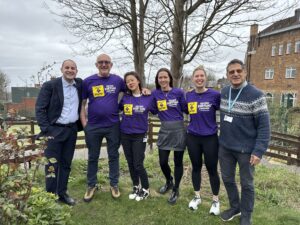
Tuesday’s Wellbeing assembly covered a completely different – but equally important – topic, and one that is vital for girls. We were delighted to welcome Team PEBE co-founder, Charlotte, to talk to the whole Senior School about the importance of a well-fitting sports bra.
I have often said that one of the joys of being Headmistress is that I get to tell girls all the things that no-one told me when I was at school, and the importance of being properly measured for a bra is very high on my list of things that every girl should know. Repeated studies have shown that at least 80% of women are wearing the wrong size bra (most of them too small) and, as a firm advocate of Bravissimo, I’m not embarrassed to say that while I may have been getting my everyday bras properly sized for the last 30-odd years, I didn’t own a sports bra until I was in my 40s.
Charlotte’s assembly presentation demonstrated very clearly why that’s a really bad idea. Slide 7 shows how our bodies move in a figure of eight motion when we exercise – just like a pony tail swishes as we run, so our breasts move too – and in three dimensions, to boot. Given that they’re supported only by skin, rather than muscle tissue, they need all the help they can get to cope with that stress! As I pointed out to the girls at the end of assembly, they’ve got to look after their bodies for decades to come and this is one simple thing they can do to ensure that at least this bit of their bodies has all the support it needs (pun definitely intended!).
Slides 9 & 10 showed the girls the simple maths involved in determining a bra size, and how to size up and down for the best fit, given that a 30F (Team PEBE’s best-selling size among teenagers), or indeed any size, can fit very differently when made by different brands. Seeing and hearing the reaction in the Sports Hall, it was clear that Charlotte had given the girls lots to think about – and I hope that you’ll be getting requests to go bra shopping with your daughters in the Easter holidays. Mums, you might want to get measured at the same time too!
I am very grateful to Ms Nelson, Director of Sport, for arranging the visit from Team PEBE. It is particularly fitting (sorry, pun not intended!) that this should happen in the same week that our U14 netball and U13A football teams both reached the finals of a major competition, and both of which took place on Thursday. Huge congratulations to the U14 netballers, who travelled to Loughborough University to play in the Elite 8 of the Sisters n Sport competition. The players narrowly missed out on the final, losing by 1 to Loreto Grammar School in the semi finals. They then faced Trent College in the 3rd and 4th place play-off and beat them 23-17 in an exciting match, to finish third overall in a national competition which involved over 300 schools.
At the same time our U13A football team were playing in the Middlesex Schools Cup final here in London. 68 schools entered the competition this season and our team had played – and won – four rounds of matches to reach the final against Fortismere School. Sadly they lost 5-1 but the score did not reflect the performance of the game, and the team should be very proud of their skill and determination throughout the season. Who says Channing isn’t a sporty school?!
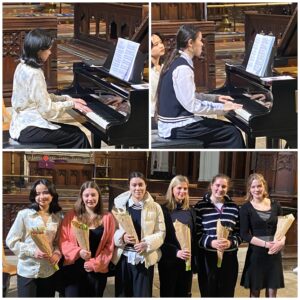
Finally, a brief note to congratulate Mr Boxall, all our music teachers and our fantastically talented musicians on a wonderful Spring Concert last night. The challenge of a varied programme of extraordinarily ambitious music, from Schubert to Saint-Saens via Elgar and Mendelssohn, among others, was amply met by the girls. For our thirteen Year 13 leavers, many of whom had stunning solos on the evening, it was an emotional farewell to many years of music-making at Channing – and they did themselves proud! More to come on this next week, including a recording so you can listen again. I certainly will be.
And so to the weekend. There will be New Year celebrations going on for some of our families, to whom I wish Nowruz Mobarak, whilst I wish Eid Mubarak to those of you celebrating at the end of Ramadan. However you are spending the weekend, I wish you the joy of family and friends.
With warmest wishes
Lindsey Hughes
Headmistress


 he sadness of the song. Next up, we had the inaugural performance of the new Performing Arts Workshop, coached by Mr Davies. They started with Falling Slowly from the musical Once, using simple harmonies and simple staging to very effectively encapsulate the sentiment of the song. Their next performance was Shadowland from The Lion King, which they used to explore the experience of refugees leaving home. This was powerfully delivered, again with simple staging for maximum effect.