 VISIT US
  CONTACT US
  SUPPORT US
 APPLY NOW
Word from the Head – 25 September 2026
Dear Parents,
It is hard to believe that we are half way to half term already! With the sun still shining – even if the mornings are darker and a little chillier – part of me is still clinging on to the last vestiges of summer. On the other hand, as timetables become familiar, routines start to embed and extracurricular activities are up and running, we can feel the buzz and energy of school life in full flow around us.
One source of that buzz was the fabulous Channing Marketplace which took place in the Sports Hall on Sunday. The Channing Association team, masterminded by Co-Chair Mrs Wenninger, put together a wonderful array of stalls, food and activities. I was struck by how many were run by Channing parents – there is clearly a huge amount of creativity and entrepreneurship in our community! You can read more about the event in the section below but for now, my enormous thanks to Mrs Wenninger and all those who volunteered, had a stall or visited on Sunday. It was a marvellous event.
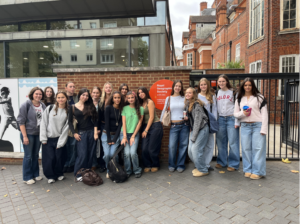
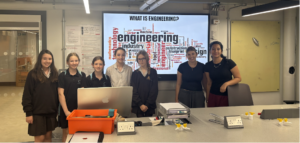
We are also very excited for the group of 30 Year 11 and Sixth Form students who are off to Copenhagen today for their annual STEM trip. Many thanks indeed to Mrs Berry for leading their packed schedule, and to Dr Spinks, Miss Williams and Mrs Wootton for accompanying the girls. I look forward to hearing all about it next week.
This week I have asked two guest editors to take over Word from the Head to write about something we think is integral to Girls Enjoying Success: reading.
“At the start of term, Mrs Hughes wrote to you about the challenges that inevitably accompany the joys of learning. Education does not end with university; it is, as you all know, a lifelong journey. What often makes this journey difficult is not the lesson itself but a lack of resilience and a hesitation to scramble into the cavernous depths of the Learning Pit.
With this in mind, we wanted to think about what the Learning Pit looks like for reading, especially at a time when reading for pleasure amongst young people is at an all-time low, and the Department for Education has declared 2026 a National Year of Reading.
While the current discourse around Britain’s decline in reading feels uniquely modern, panic over changing reading habits is hardly new. What’s interesting is that with each significant cultural shift, the anxieties it has produced remain largely unchanged. During the Restoration, the print revolution made it possible for anyone to publish their opinions for a small fee and, as books became less expensive, more and more people had access to the latest discoveries in science, to literature and political theory. This gave rise to serious concerns about the reading subject’s ability to discern fact from fiction, the credible from the ridiculous. Jonathan Swift’s prose parody A Tale of a Tub (1704), uses the image of a stinking, swarming crowd – known then as a ‘press’ – to satirise an industry saturating the market with the work of hacks and frauds. This disquietude around authenticity and quality remains more or less unchanged today as Grub Street is superseded by the digital landscapes of social media and the internet.
Fast forward 200 years and it seems the Edwardians were also deeply concerned about changes to reading habits. In 1906 journalist W.T. Stead published A Plea for the Revival of Reading. He believed that Britain faced a reading crisis because fewer people were reading books and were instead content with skimming newspapers while commuting on trains, forgetting what they had read by lunchtime. With the development of social media and AI technology this type of rushed, inattentive reading is on the rise once more. It takes no time at all for an AI chatbot to generate digestible summaries of any text type ranging from a legal document to the equally unintelligible Finnegans Wake.
Educational specialist Alex Quigley grimly observes that as ‘hasty reading’ begins to replace the kind of reading that is deep, difficult and sustained what is lost is the learning:
You are meant to find some reading hard. Some sentences don’t make sense, but you read them again. You check back in the text. Then it starts to make more sense. This is the deeper reading that creates the level of friction and difficulty that children – both young and old – need to read to learn.
So, how can we create this friction? What can we do at Channing to equip our students with the necessary skills to navigate the difficulties of ambitious vocabulary, archaic language, florid prose and unfamiliar forms?
Reading remains a priority across the school and is embedded in every aspect of our curriculum. Monday form-time reading plays a particularly important role in creating a culture that nurtures deep and sustained reading. It’s a time when the screens are put away, when students’ only focus is the book in front of them. Whether reading independently or aloud together, students build shared literary experiences.
It is precisely these experiences, created through ‘book chat’ with peers, friends, teachers and family members, that help students to navigate the tricky terrain of the Learning Pit. When students are confronted with characters whose motivations are ambiguous, perplexing plots or unfamiliar language, discussion provides the ladder out.
Ultimately, these moments help to forge identities as readers, something which current research has come to recognise as central to developing a lifelong love of literature. If young people do not learn to recognise themselves as readers or discover their own literary tastes, the will to read will simply not develop.
Crucially, this approach underpins our core Channing Learning Behaviours. By encouraging students to embrace challenging texts, reading helps them become:
- Ambitious: extending themselves beyond familiar authors, genres, and comfort zones;
- Reflective: processing complex ideas and developing their own literary tastes;
- Collaborative: sharing recommendations and navigating tricky narratives together;
- Organised: building regular, independent reading habits.
Reading therefore contributes not only to pupils’ literacy and wider knowledge, but also to the kind of independent, engaged learners we want them to become.
We look forward to continuing this work at school, and we invite you to join the conversation by sparking your own ‘book chat’ at home.”
Dr Hayward (Reading Coordinator & English Teacher)
and Mr Boardman (Lead for Research & Professional Learning & Geography Teacher)
As US President Harry Truman is reputed to have said, “Leaders are readers”, and I endeavour to model the reading habits we would like our pupils to develop. As many of you know, I had a small foot operation at the start of the summer holiday and the enforced rest enabled me to make huge inroads into my reading pile. Here’s what I got through:
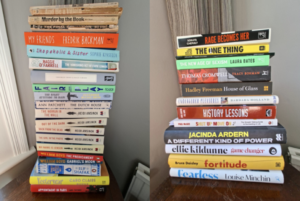
I had planned to read an equal amount of fiction and non-fiction (I find it very hard to read non-fiction in term time) – but, as you can see from the pile on the left, I got sidetracked by a deep dive into the crime thrillers of Heidi Amsinck and, at the very top of that pile, four of my father’s original 1960s paperbacks of Rex Stout’s extraordinary private detective, Nero Wolfe. They immersed me in two very different worlds – exactly the escapism that good novels bring. My highlights for great narratives include My Friends by Fredrik Backman and House of Glass by Hadley Freeman, while for sheer feminist power I offer you The New Age of Sexism by Laura Bates and Rage Becomes Her by Soraya Chemaly, itself a recommendation from a Channing parent. Whatever you – and your children – are reading, enjoy!
A couple of notices for this week. Firstly, a reminder that we are very keen to find some parent volunteers for our Sixth Form interview and assessment skills event on Monday 9 November from 1.15 – 3.15pm here at school. The aim is that all students can experience a short role-play practice interview with an adult they don’t know. You’ll be given a script and a briefing from our Careers team – please see the section below for more information and to sign up. We would be most grateful for your help.
Secondly, we have now published the term dates for the 2027-28 academic year on our website: please find them here for reference.
Finally, our thoughts are with everyone affected by yesterday’s terrible tragedy here in Highgate. We have worked hard to support our students in school today and are enormously proud of how they have managed this sad situation for themselves and their friends. We have also really appreciated the kind words you have offered us and our colleagues at Highgate.
With warmest wishes for the weekend and Chag Sameach to all our families celebrating Sukkot from tonight,
Lindsey Hughes
Headmistress